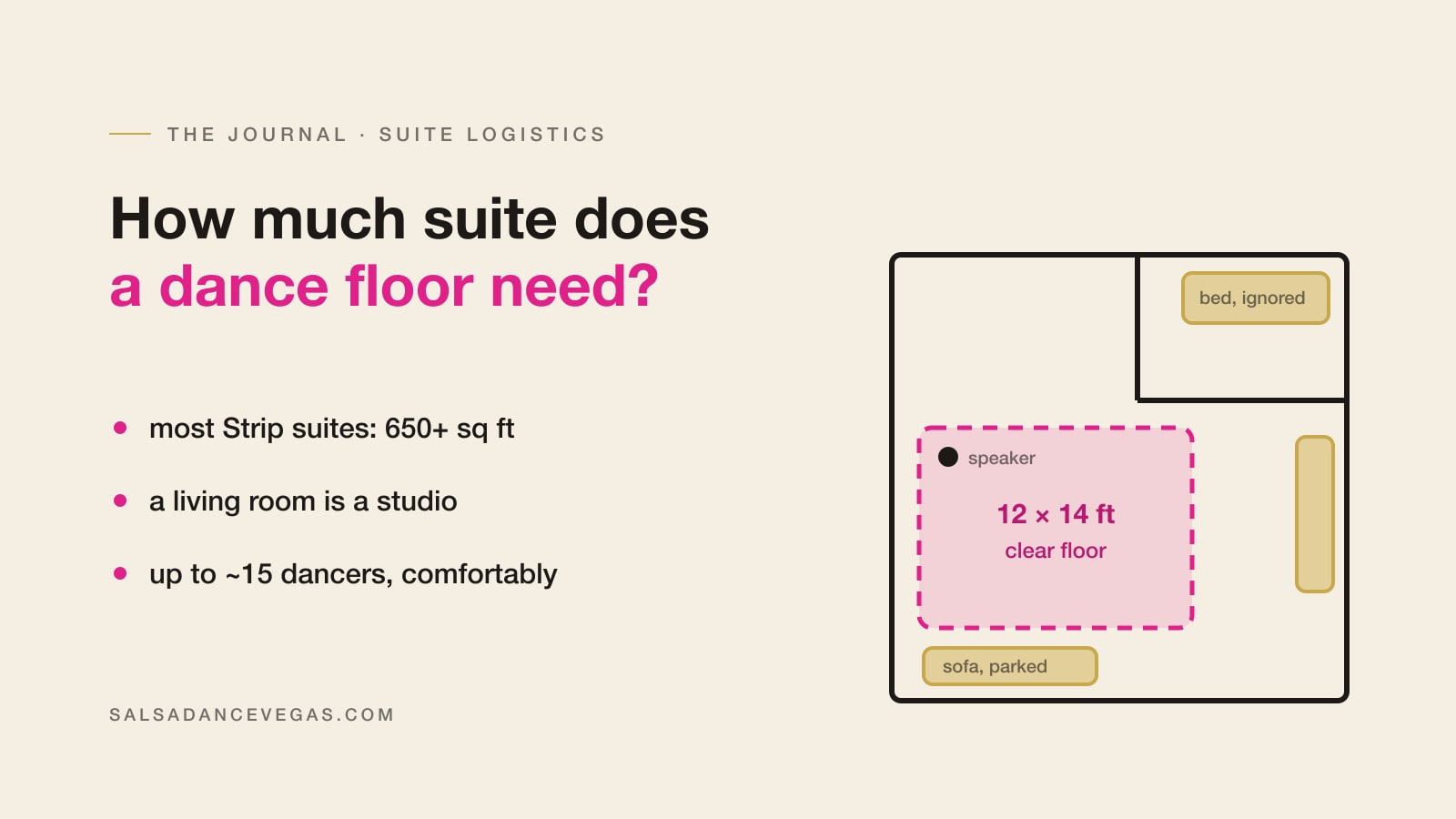
A private dance class needs roughly a 12×14 ft patch of clear floor — and by that standard, most of the Strip qualifies: the smallest suite at the all-suite Venetian is 650 square feet with a separate living area, and every hotel below publishes bigger. We teach in these rooms every week, from $199 couple's sessions to $600 private parties for up to 15, so this guide is the one a studio can't write: which suites actually have the room, what the hotels and the county actually allow, and how the music works.
Every square footage and policy line below comes from the hotels' own suite pages or official Clark County and City of Las Vegas sources, checked August 2026.
- The floor-space rule
- Suites by the numbers
- What hotels allow
- The Airbnb rules
- Music
- The session
- Cost
- When a suite is wrong
- FAQ
How much floor space does a dance class need?
The working numbers from three years of in-suite sessions: a couple needs about 10×10 ft; a group of 10–12 needs about 12×14 ft — the footprint of a typical suite living area once the coffee table and one armchair move; and 15 dancers want 300+ clear square feet, which is where the larger one-bedroom and hospitality suites earn their rate. Salsa and bachata are compact by design — they were invented for crowded floors — so nobody needs a ballroom. Carpet is fine for basics; smooth-soled shoes or socks handle the turns.
The translation into hotel-speak: what matters isn't total square footage, it's whether the room has a separate living area. A 650 sq ft suite with a real living room out-dances a 500 sq ft single room every time, because beds don't move.
Which Strip suites actually have the room?
From the hotels' own published suite pages, August 2026 — organized by what your group actually needs:
| Suite (hotel's own figures) | Size | Fits |
|---|---|---|
| Vdara Studio Suite | 582 sq ft | Couple's session |
| Venetian Luxury King Suite | 650 sq ft | Couple to ~6 dancers |
| Cosmopolitan Terrace One Bedroom | 720 sq ft | Couple to ~6 — bedroom closes off behind telescoping doors |
| Palazzo Luxury King / Encore Resort room | 720–745 sq ft | ~6–8 dancers |
| MGM One Bedroom / Waldorf One Bedroom | 765–775 sq ft | ~8 dancers |
| Bellagio Salone Suite | 853 sq ft | ~8–10 dancers |
| Wynn Tower Suite Parlor | 1,280 sq ft | Group of 12 with room to spare |
| Bellagio Cypress Suite | 1,525 sq ft | "Open floor plan that doubles as the perfect space for entertainment" — their words |
| Cosmopolitan Two Bedroom City Suite | 1,615 sq ft | Full bachelorette crew, sleeps the core group too |
| Encore Tower Suite Salon | 2,261 sq ft | 15+ — Wynn's page literally opens with "Entertaining?" |
And the flip side — the rooms that don't work for groups: standard single rooms run 350–510 sq ft (MGM Grand Studio 350, Cosmopolitan City Room 460, Caesars Colosseum rooms 350–475, Bellagio Premier 510, Waldorf Deluxe 500) with no separate living area. Two of those hold a couple's lesson; none of them holds twelve people and a routine. If your crew booked standard rooms, put the class in whichever suite the bride or the organizer is in — one suite hosts, everyone else walks over.
How to read a suite listing like an instructor
Booking the room months before the class? Four tells on any hotel's suite page separate a dance-ready suite from a pretty one. First, the phrase "separate living area" (or "living room" as its own bullet) — that's the floor. Second, the "Max Guests" line: it's the hard ceiling on your class headcount in that room, so a crew of 12 wants a suite listing 6+ and a plan for where everyone sleeps. Third, the furniture in the photos — a floating sofa and a movable coffee table clear in thirty seconds; a built-in sectional wrapping a sunken pit does not. Fourth, words hotels use when they want you to gather: "entertaining," "hospitality," "reception," "wet bar" — those aren't decor notes, they're the marketing department telling you the room is sold for exactly what you're planning. When two suites tie on price, the one with the longer dining table wins; it becomes the phone-charging, mimosa-staging command center of the whole session.
What do hotels actually allow?
Here's the honest version, because we went looking for the mythical "no parties in suites" policy and it isn't published anywhere on the major operators' public pages. What Strip hotels actually publish is more specific and more useful:
| What's on the books | Real example (hotel's own language) |
|---|---|
| Occupancy caps per room | Venetian standard suites: max 4 guests; $50/day per extra guest 13+. MGM properties print "Max Guests" on every room page |
| Disturbance clauses | Venetian bans "any items that could cause a disturbance or damage to the suite" |
| Entertaining is a product, not a loophole | Venetian's own FAQ steers hosts to Grand, Executive, and Hospitality suites "better suited for entertaining"; Cosmopolitan sells a Reception Suite "ideal for almost any type of gathering"; Vdara a 1,600 sq ft Hospitality Suite; Caesars markets a villa with "Throw the ultimate party" |
What that means in practice for a dance class: your registered group, inside your suite's occupancy limit, learning a routine with an instructor at conversation-plus volume, is a private gathering — the thing the room is sold for. The line you don't want to cross isn't dancing; it's headcount (twenty people in a suite registered for four) and noise that leaves the room. For groups bigger than your suite's cap, the hotels themselves sell the answer — hospitality and entertainment suites built for exactly this, and corporate-sized groups can use a meeting room at the same property. Where a specific property wants advance notice for organized events in suites, we have that conversation with you before your date is confirmed — it has never once been a dealbreaker, but it should never be a check-in surprise either.
What about Airbnbs? (the actual rules)
This is where a Vegas group most needs real information, because the county and the city both regulate short-term rentals hard — and the rules are the opposite of folklore:
Unincorporated Clark County (which includes the Strip): operating an STR without a license is unlawful, and the county's application window closed in August 2023 — supply is capped. Licensed units are limited to 2 guests per bedroom, max 10 per unit, and "parties, weddings, events, or other gatherings which exceed the maximum occupancy" are flatly prohibited. Most striking for Strip-adjacent dreams: licensed STRs must sit at least 2,500 feet from any resort hotel — so a legal Airbnb next door to the Strip essentially does not exist.
City of Las Vegas: the city's code-enforcement page says it plainly — "weddings, birthday parties, bachelor/bachelorette parties and other types of special events are not allowed" at short-term rentals, outside music audible 50 feet from the source is a municipal violation, and the ordinance restricts amplified sound to inside the unit.
Practical read for a dance class: a licensed rental, your group inside its occupancy cap, class indoors with the instructor managing volume — that's a private stay behaving itself, and it's how our rental-house sessions run. A 14-person blowout in a 3-bedroom rental is a different thing, and the county wrote the rule about it. When your group is bigger than a legal rental allows, that's precisely when the hotel suite — with its published occupancy and its hospitality-suite upgrade path — is the better host. Check the license before you book the house; the whole weekend rests on it.
The music question
No Strip hotel publishes a decibel rule for rooms — we checked — so the operating rules are the disturbance clause and common sense. Ours: one portable, self-powered speaker; volume set for the room, not the hallway; interior living rooms, not balconies; and daytime-to-early-evening scheduling, which is when groups want the class anyway (the 5pm pre-dinner slot is the house favorite). In three years, zero noise conversations with hotel security — a salsa class at teaching volume is quieter than most in-suite pregames. At rental houses the rules above make it even simpler: the class happens indoors, full stop.
How the session actually runs
Minute by minute, it's simpler than any venue logistics above: your instructor arrives at the suite or rental with a curated playlist and portable sound, the coffee table slides aside, and the living room becomes the dance floor. A typical session runs 60–90 minutes — salsa and bachata basics that get everyone moving inside ten minutes (including the friend who "will just watch"), a short group choreography, and a staged photo-and-video finale for the phones. There's no equipment for you to arrange and no experience required, and every class is LGBTQ+ inclusive with no assumed roles — anyone leads, anyone follows. Where a specific property wants advance notice for an organized gathering, we handle that conversation before your date is confirmed, so nothing gets awkward at check-in.
What does an in-suite class cost?
Same rate card everywhere on this site, because there's one rate card. Travel to your suite or rental is included across the Strip, Downtown, Summerlin, and Henderson:
| Format | Price | Room it needs |
|---|---|---|
| Single private session | $150 | Any suite; even a large single room |
| Date night, per couple | $199 | ~10×10 ft — every suite on the table above |
| Bachelorette, up to 12 | $550 +$35/extra | A one-bedroom suite's living area |
| Private party, up to 15 | $600 +$30/extra | Larger one-bedroom or hospitality suite |
| Corporate teams | $85/guest for 8–19 ($695 min); $2,000 for 20 +$75/guest | Hospitality suite or meeting room |
If you're mid-decision between hosting in the suite or taking the group to a studio, the suite vs. studio comparison runs that math head-to-head — and the session itself is covered minute by minute just above.
When a suite is the wrong venue
Three cases, honestly. Your group outnumbers every room you've booked — twenty dancers can't inhabit a suite registered for four, and pretending otherwise is how security gets involved; book the hotel's hospitality suite or a meeting room, or trim the class list to the core crew. You want equipment — poles, aerial rigs, and sprung floors live in studios, and a studio is the right booking for them. Nobody's accommodation has a living area at all — if the whole party is in standard rooms and there's no rental house, a studio's open floor wins that weekend. Everything else — convenience, privacy, per-head math, photos with your own skyline out the window — the suite takes.
Suite dance class FAQ
How much space does a private dance class need? About 10×10 ft for a couple, 12×14 ft for a group of 10–12 — a typical suite living area once the coffee table moves.
Do Las Vegas hotels allow dance classes in suites? A class for your own registered guests, inside the suite's occupancy limit, is a private gathering — what suites are sold for. Hotels publish occupancy caps and disturbance rules, not dance bans; larger groups should book hospitality-style suites, which hotels market for entertaining.
Can we host a dance party at a Las Vegas Airbnb? Only within the rules: the rental must be licensed, your group must fit its occupancy cap (Clark County: 2 per bedroom, max 10), and events beyond occupancy are prohibited — City of Las Vegas rules bar bachelor/bachelorette parties at STRs outright. An indoor class for a group within occupancy is the compliant version.
What about music volume? One portable speaker at room volume, indoors, daytime or early evening. Hotels publish disturbance clauses rather than decibel numbers; rental rules restrict amplified music to inside the unit.
What does an in-suite class cost? From $150 for a single private session to $600 for a private party of up to 15, travel included across the Las Vegas valley.